
Which Mold Repair Strategy Is Right for You?
Published June 8, 2026
By Jacob Huben
Not Every Mold Repair Looks the Same
When a Repair Isn’t One-Size-Fits-All
When your mold goes down, every hour it sits off the press costs you. The fastest repair feels like the most obvious move. But speed without diagnosis tends to trade one shutdown for several more down the line.
Not every mold repair calls for the same approach. A mold with three weeks left before a replacement comes online needs something different than a mold with two million cycles ahead of it. Choosing the wrong approach in either direction is costly: too aggressive and you’ve spent time and money the mold didn’t need; too conservative and you’re back at the bench sooner than expected.
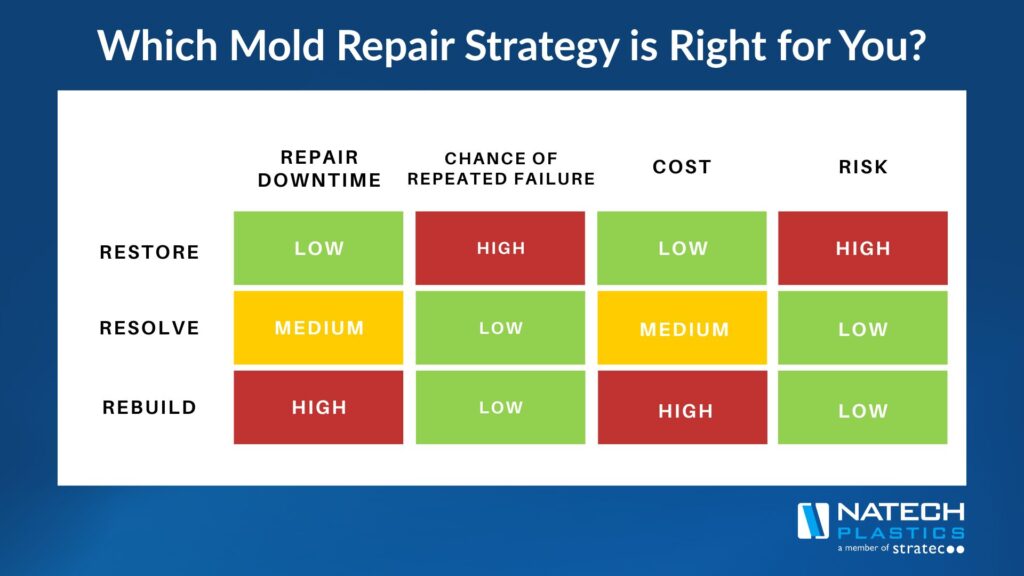
At Natech, every repair starts with a conversation about which of these three approaches best fits your situation: Restore, Resolve, or Rebuild.
1. Restore: Get It Back in the Press
A Restore is a targeted fix to the visible damage. You’re not diagnosing the root cause. You’re getting the mold running again as fast as possible, knowing the underlying problem may not be fully resolved.
This is the right call when the mold is near end of life or the cost of extended downtime outweighs the risk of the problem recurring. It’s a deliberate business decision instead of a hasty shortcut.
One client brought in a mold running well past its expected cycle count, with a replacement arriving twelve weeks out. A full teardown would have taken longer than the window they had. We patched it, ran it, and transitioned cleanly when the new tool arrived. No gap in production.
On a mold with years of production life remaining, that same decision tends to compound the problem. Skipping diagnosis means the underlying cause keeps building, and each return visit ends up costing more than the investigation would have.
2. Resolve: Fix What’s Actually Broken
A Resolve starts with diagnosis. Before you fix anything, you find the root cause, then correct the specific condition driving the failure. The mold comes back with the actual problem addressed, not just the symptom.
Two molds can arrive with the same broken core pin and need completely different repairs: one has an undersized pin, the other has warped cavity plates that have been stressing the pin for months. Fix the pin on the second mold without knowing that, and you’re practically scheduling the next repair at the same time.
One aluminum mold arrived with flash forming around small core pins. When our toolmaker opened it up, he could see the pins were coining into the opposite side of the mold, burying themselves in, which pointed to a deeper structural problem. Despite our recommendation to investigate, the client opted for a Restore, prioritizing speed. We increased the preload on the pins and returned the tool to production. They got about 500 shots before it failed again.
On the second visit, we ran a full investigation. What it revealed had nothing to do with the pins: warped cavity plates, core blocks that weren’t square, and alignment issues that had been compounding long before anyone looked past the pins. The mold ran without issue once corrected. A repair that took a few extra days on the first visit would have avoided the second one entirely.
However, a Resolve also has its limits. When diagnosis uncovers wear accumulated across the entire tool, or problems that trace back to how the mold was originally built, correcting individual components won’t hold. That’s when a Rebuild is the only answer.
3. Rebuild: Start From a Stronger Foundation
A Rebuild is for when diagnosis reveals the mold is beyond what a targeted fix can solve. Sometimes that means a structural overhaul of the existing tool. Sometimes it means replacing it entirely. The goal is to address what made repeated failure inevitable, not just the most recent one.
One client ran a high-volume part for a blood testing instrument out of a small custom mud frame. It was never built for the production demand they were putting through it. The mold came in for repairs constantly.
Natech built the new tool while the old one kept production running. The client validated it before the old one failed again and brought it online without any gap in production. The rebuild paid for itself before the first shot was pulled.
Reworking an existing tool only makes sense when the mold has enough production life ahead of it to justify the investment. A tool a few months from retirement is better served by a Restore.
The Conversation That Determines the Repair
The right approach depends on the mold’s condition, its remaining production life, the cost of downtime, and what diagnosis actually finds once it’s on the bench. There’s no one-size-fits-all solution, which is why that conversation happens before any work begins at Natech.
We lay out your options honestly before we any work begins. That’s including what each one is likely to cost if it turns out to be the wrong call. The repair that fits your mold, your timeline, and your production is the one worth doing.